Ad lectorem
This catalogue presents an outstanding collection of 100 artworks and early printed books showing the most famous emblem in the history of printing, the dolphin curled around an anchor.
Adopted by the Manutius family to mark their Aldine editions from 1502 onwards, this device is also an everlasting trademark, with a version of it still used in today’s publishing industry. Due to its connection with the celebrated publications by Aldus and heirs, it has been adapted, copied and forged hundreds of times.
Aldus chose the emblem of the anchor and dolphin to illustrate the Latin adage festina lente. By claiming it as his own device, Aldus gave “fresh celebrity to the same device that was once approved by Vespasian”. It is not only “most familiar, it is highly popular among all those everywhere in the world to whom learning is either familiar or dear. Indeed, it had perhaps become too popular, for the city of Venice, with its many claims to distinction, has none the less become distinguished through the Aldine press, so much so that any books shipped from Venice to foreign countries immediately find a readier market merely because they bear that city’s imprint”.
According to Erasmus of Rotterdam, it was the young Pietro Bembo who had given Aldus a silver denarius of the Roman emperor (whom the Dutch scholar misidentified asVespasian) with a dolphin curled around an anchor on the reverse (Erasmus, Adag. 2.1.1, p. 10). This image, he argued, represented σπεῦδε βραδέως, an ancient saying attributed to Augustus here translated as festina lente, which Aldus had adopted as a motto and which Erasmus first expounded in the 1508 Aldine edition of his Adagia.
Aldus gave his readers an initial glimpse of the motto in July 1498, in the dedication letter of his edition of the Opera omnia of Angelo Poliziano to the Venetian patrician, humanist and diarist Marin Sanudo. Claiming that it had been Sanudo himself who had encouraged him to undertake the Poliziano project,Aldus also credited him with a key piece of advice:
“Ex quo itaque accepistiAngeli Politiani,summo viri ingenio et singulari doctrina, lucubrationes excudi formis in aedibus nostris, me, ut editionem accelerem, hortari non desinis,quod summi ingenii labores praestanti ipse ingenio legere concupiscas, addito tamen Graeco adagio σπεῦδε βραδέως”
In October 1499, in the dedication letter of the Scriptores astronomici veteres to his great patron and former student Alberto Pio,prince of Carpi,Aldus for the first time made reference to the anchor and dolphin, though without explicit connection to the motto nor indeed any pictorial illustration:
“Etsi scio a plerisque me tarditatis crimine accusari,Alberte, praesidium meum, quod plurimum differe videar,quae toties pollicitus sum studiosis dare,tamen has literatorum querelas aequo animo ferendas ducimus,tum quia possum vel graviora perferre, dum prosim, tum etiam quod sum ipse mihi optimus testis me semper habere comites, ut oportere aiunt, delphinum et ancoram. Nam et dedimus multa cunctando et damus assidue”
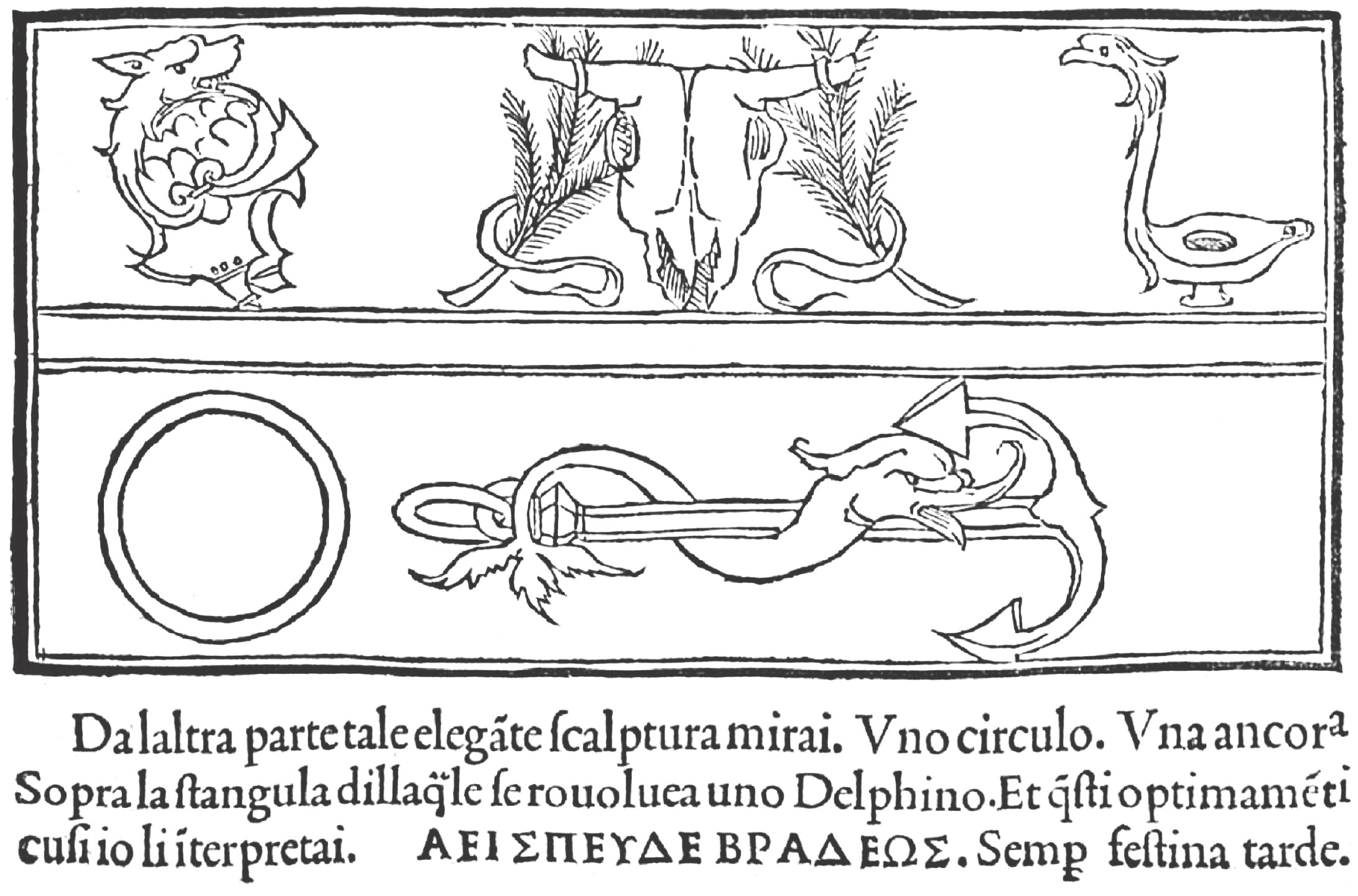
Two months later (December 1499), an image of the anchor and dolphin appeared in the Hypnerotomachia Poliphili, depicted in the form of one of two hieroglyphic reliefs encountered by the narrator on a bridge.The first time this image appeared in print, it was also the first time σπεῦδε βραδέως was translated into Latin, though, as we have seen, here as festina tarde.
Then, in the second volume of the Poetae Christiani Veteres (1501-1502), the anchor and dolphin made its initial appearance as the printer’s device. Subsequently, in his warning against the counterfeit printers of Lyon issued in March 1503, Aldus identified the device as a guarantee of authenticity, and thus of quality, and depicted it at the bottom of the page (see illustation on page 8).
Despite attempts to protect it, the press’s collapse in 1598 and the unfolding of time,the Aldine device kept being exploited and mishandled by established publishers as well as provincial printers across Europe.The scope was crystal clear:improve the appeal of their books and increase the status of their output. By using an anchor device, printers could capitalize on the authority and prestige of the Aldine press, an act of appropriation and allusion that would be re-enacted by numerous publishing firms in Aldus’ times and over the following centuries. And it is in that spirit that the anchor device has lent itself to a variety of uses.
During the golden age of European Aldine collecting in the early 19th-century, bibliophiles started recognising the importance of this phenomenon as a testimony to Aldus’ unrivalled reputation long after his death in 1515. In his Annales de l’imprimerie des Alde,Antoine-Augustin Renouard recorded several early publications containing visual or textual references to the Manutius, and regarded them as indispensable items in a perfect Aldine collection. Samuel Butler, Bishop of Lichfield, possibly the greatest Aldine connoisseur of all times, further expanded this category. When his comprehensive collection was sold by Christie’s on 1 June 1840, the alert to buyers listed all the different notions of Aldine collectibles and ended with ‘Books printed with the Aldine device, (the Anchor), in Italy, France, Spain, England, &c.’.
Through Aldus, the device reached such a universal fame that we can retrace it even in early modern works of art; three remarkable examples are provided herein, ranging from Renaissance ceramics to 17th-century French and German coins.
Rooted in the history of Aldine bibliophilia, the present catalogue offers a vast array of non-Aldine publications bearing the anchor and dolphin, from the
1570s to the mid-18th-century. Most of them were previously unknown to standard bibliographies on the Manutius’press,featuring an impressive number of variants of remarkable Geneva imprints to be smuggled into France and Italy.
Festina lente